
Moving to the mountains is a dream for many, and turning it into reality is far smoother with a clear roadmap. Relocating to Murphy, NC — or anywhere across the far-western North Carolina and North Georgia mountains — typically unfolds as a sequence: an exploratory first visit, narrowing down the area and property type, lining up financing, searching (often partly from a distance), and finally making an offer and closing. Because many buyers are coming from elsewhere and may be purchasing a second home, a little structure goes a long way. This step-by-step guide walks the path from first visit to closing, with the practical logistics to line up along the way, so your move feels organized rather than overwhelming.
Key Takeaways
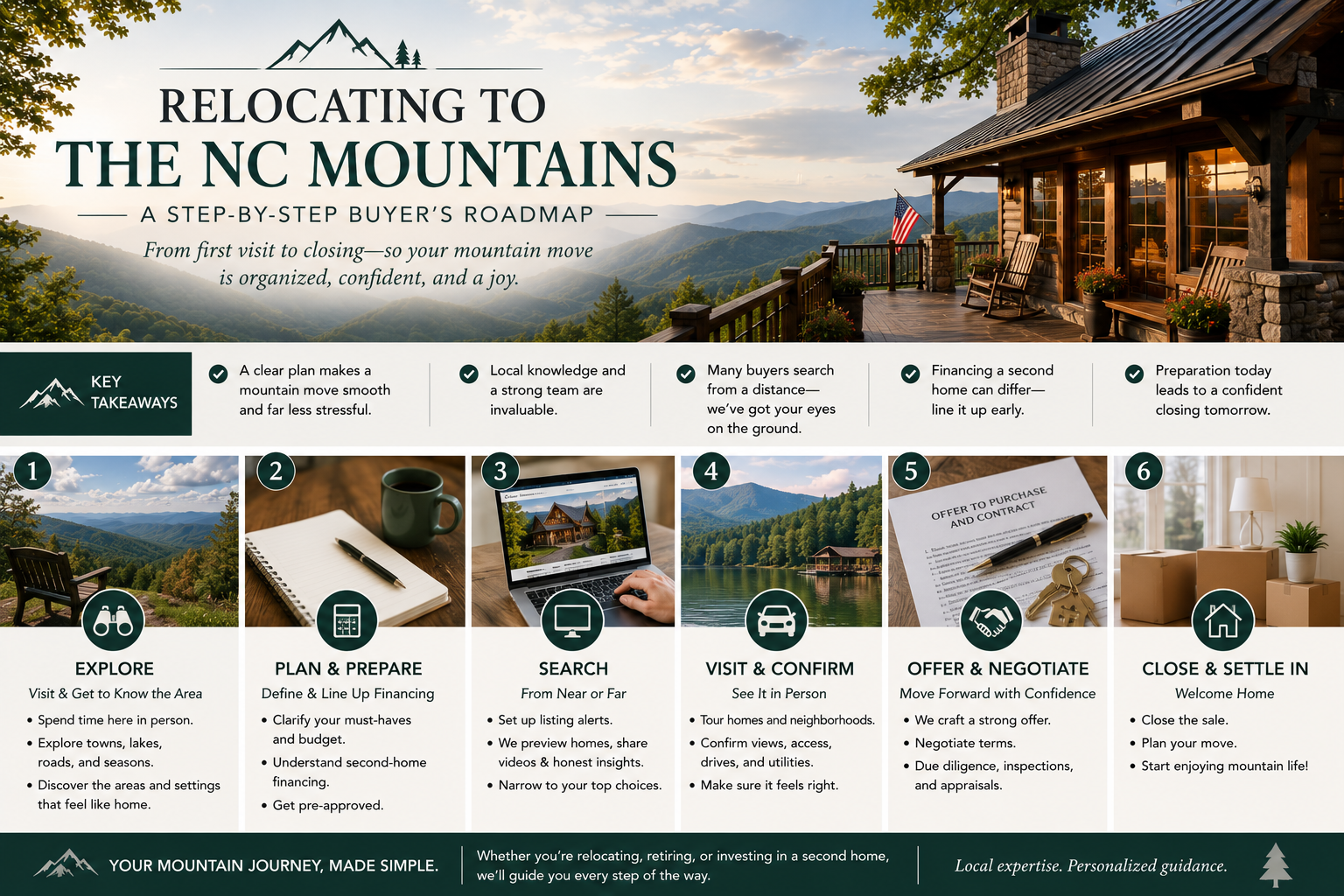
- Relocating works best as a sequence: explore, narrow down, finance, search, offer, close.
- An exploratory visit helps you learn the towns, areas, and property types firsthand.
- Financing a second home or relocation can differ from a primary residence — line it up early.
- Much of the search can be done remotely with a local agent as your eyes on the ground.
- A clear plan and a local team make a move from a distance organized and far less stressful.
Step 1: Explore and get to know the area
The first step is simply to spend time here and learn the lay of the land. The far-western mountains span several towns and counties — Murphy, Andrews, Hayesville, Robbinsville on the North Carolina side, and Blairsville, Blue Ridge, Hiawassee across the Georgia line — each with its own character, setting, and feel. An exploratory visit, ideally across more than one season if you can, helps you sense which areas resonate, what kind of setting you want (lake, long-range view, in-town, acreage), and the practical realities of mountain life like drive times, terrain, and the rhythm of the seasons. Drive the roads, visit the towns, see the lakes, and imagine your daily life in different spots. This is also the time to learn the practical landscape — where the towns and services sit, how connectivity and utilities vary, what year-round living looks like versus seasonal use. A knowledgeable local agent is invaluable here, offering an honest orientation to the areas and helping you focus your search. The clearer your sense of place after exploring, the more efficient and confident every step that follows will be.
Step 2: Define your search and line up financing
With a feel for the area, the next step is to define what you're looking for and get your financing in order:
- Clarify your priorities — area, property type, must-haves (view, lake access, single-level living, acreage), and budget.
- Understand second-home financing — financing a second home or relocation can differ from a primary residence in down payment, rates, and terms; talk to a lender early.
- Get pre-approved — a pre-approval clarifies your budget and strengthens your position when you find the right home.
- Consider the logistics — timing relative to selling a current home, the move itself, and any rental income plans, verified for the specific property.
Getting financing lined up early means you can move quickly and confidently when the right property appears, which matters in a market where good homes can go fast.
Step 3: Search — including from a distance
Much of the modern home search happens online and can be done from wherever you currently live, with a local agent serving as your eyes and ears on the ground. Set up listing alerts for your criteria so you see new properties as they hit the market, and lean on your agent to preview homes, share detailed video walkthroughs and photos, and give you honest assessments of properties and their settings — including the things that don't show in a listing, like the quality of a view, the steepness of a driveway, or the feel of a neighborhood. When promising candidates emerge, plan focused visit trips to tour the shortlist in person, since seeing a mountain property firsthand is important before buying. Remote searching has become remarkably effective, with virtual tours and responsive communication bridging the distance, but the in-person visit to your top contenders remains valuable. Throughout, clear communication with your agent about what's working and what isn't keeps the search efficient. This blend of remote searching and targeted visits lets you conduct a thorough search without living out of a suitcase, and it's how many relocating buyers successfully find their mountain home from afar.
Step 4: Offer, due diligence, and closing
When you find the right property, the final steps move from searching to securing it. Your agent helps you craft a competitive, sensible offer and negotiate the terms. Once under contract, the due-diligence period is when you verify the things that matter on mountain property — inspections of the home, the well and septic, and any moisture or structural concerns, plus confirmation of access, any dock or shoreline rights on lake property, and the systems and disclosures. This is the time to confirm rather than assume, and a local agent helps coordinate the inspections and specialists. Financing is finalized, title is examined, and the closing is scheduled — often handled with electronic signatures and minimal travel if you're relocating from a distance. After closing comes the practical setup of a move: arranging utilities, updating your driver's license and registration if you're becoming a resident, and the rest of the new-home logistics. With each step handled in order and a local team coordinating the on-the-ground details, the path from offer to keys-in-hand is orderly and clear. Then the best part begins: settling into the mountain life you came for.
The relocation roadmap at a glance
| Step | What to do |
|---|---|
| 1. Explore | Visit, learn the towns and areas, sense the setting you want |
| 2. Define & finance | Set priorities and budget; line up financing and pre-approval |
| 3. Search | Use alerts and remote tools, with targeted in-person visits |
| 4. Offer & close | Negotiate, do due diligence, finalize financing, and close |
Settling in after the move
The roadmap doesn't quite end at closing — the final, rewarding phase is settling into your new mountain life, and a little planning here pays off too. Once you have the keys, there's the practical setup of any move: arranging utilities and services, handling any address and registration updates if you're becoming a resident, and learning the practical landscape of where things are and how you'll go about your days. Beyond the logistics, settling in is also about connecting with the community and the place. Newcomers often find the mountains welcoming, and simple steps — visiting the farmers markets, exploring the towns and trails, getting to know neighbors — help a new house quickly start to feel like home. Giving yourself time and patience helps, since adjusting to a rural mountain rhythm, with its longer drives and slower pace, is part of the transition many people come here precisely to embrace. Many relocating buyers find that the move, daunting as it can seem from a distance, gives way surprisingly quickly to a settled, contented feeling once they're here and exploring. With the purchase handled in clear steps and a local team that knows the area, you can focus your energy on the best part of all — beginning the mountain life you set out to find. That, after all, is the whole point of the journey.
Frequently Asked Questions
How do I start relocating to the NC mountains?
Start by exploring the area on a visit to learn the towns, settings, and property types and sense which resonate. From there, define your priorities and budget, line up financing, and begin searching with a local agent. A clear sequence keeps the move organized.
Can I search for a home remotely?
Yes. Much of the search can be done remotely using listing alerts and a local agent who previews homes, shares video walkthroughs, and gives honest assessments. Plan focused in-person visits to tour your shortlist before buying.
Is financing a second home different?
It can be. Financing a second home or relocation property may differ from a primary residence in down payment, rates, and terms, so talk to a lender early and get pre-approved to clarify your budget and strengthen your position.
What should I verify during due diligence?
On mountain property, verify the home inspection, well and septic, any moisture or structural concerns, access, and any dock or shoreline rights on lake property, plus the systems and disclosures. Confirm rather than assume during the due-diligence period.
Can I close on a home from out of state?
Often, yes. Closings can frequently be handled with electronic signatures and minimal or no travel, and a local agent coordinates the on-the-ground details. Many relocating buyers complete their purchase largely from a distance.
Your move, made easier
A clear roadmap and a local team turn a mountain relocation from daunting to doable. The DuPree Real Estate Group guides relocating buyers from the first exploratory visit through closing. When you're ready, you can browse current listings around Murphy, read about getting set up in the area, or reach out to Bonnie DuPree to start planning your move.
The DuPree Real Estate Group is pledged to the letter and spirit of U.S. policy for the achievement of equal housing opportunity. Bonnie DuPree, REALTOR® · RE/MAX Town & Country · Each Office Independently Owned and Operated.
Check out this article next