
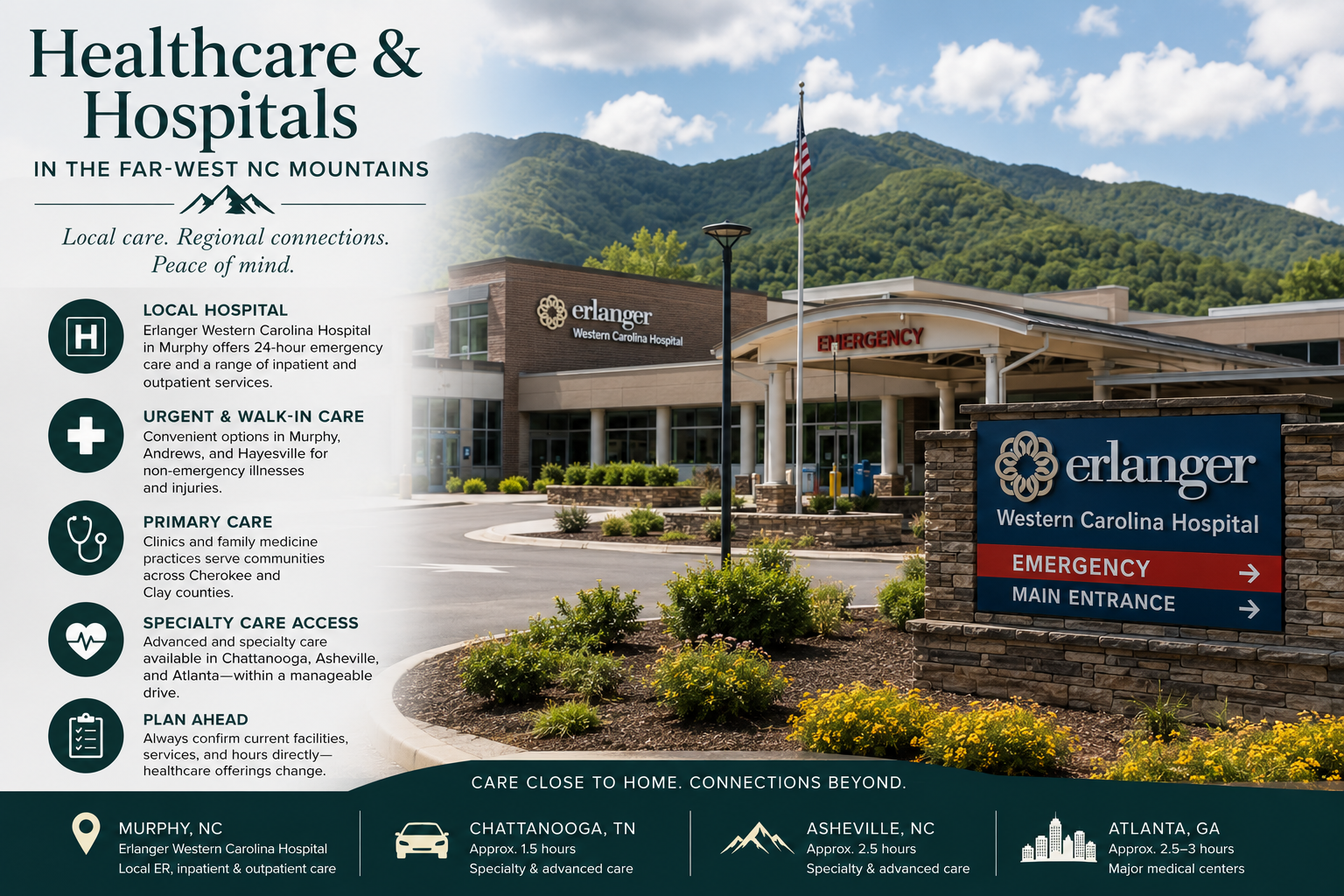
For anyone considering a move to the mountains, healthcare access is a practical question worth understanding early. Hospitals and healthcare near Murphy, NC are anchored by a local hospital in town, with urgent and walk-in care, primary care clinics across Cherokee and Clay counties, and larger regional medical centers within a couple of hours for specialty needs. The picture is reassuring: day-to-day and emergency care is available locally, while more specialized care involves a manageable drive to a city. Here's a factual overview of what to expect for healthcare in the far-western North Carolina mountains and the nearby Georgia communities. It's a question that deserves a clear, factual answer rather than guesswork, because peace of mind about care is part of what makes a mountain move feel right — and the reality here is more reassuring than many people expect before they look into it. Below, we walk through the local hospital, the urgent-care options, primary care, and what traveling for specialty care really looks like, so you can plan with a clear and accurate picture rather than vague worry. The short version: the essentials are close, and the specialized care that requires a city is a manageable, well-traveled drive away, the kind of routine trip that local residents make without much fuss whenever the need happens to arise.
Key Takeaways
- Murphy is home to a local hospital with 24-hour emergency care, part of a regional health system.
- Urgent and walk-in care is available in Murphy, Andrews, and Hayesville for non-emergencies.
- Primary care clinics serve communities across Cherokee and Clay counties.
- Specialty and advanced care typically involves travel to Chattanooga, Asheville, or Atlanta.
- Always confirm current facilities, services, and hours directly, as healthcare offerings change.
The local hospital
At the center of healthcare in the area is the hospital in Murphy — Erlanger Western Carolina Hospital, formerly known as Murphy Medical Center, now part of the Chattanooga-based Erlanger Health System. It operates as a critical-access hospital with around-the-clock emergency care, along with a range of inpatient and outpatient services that have included areas such as family medicine, general surgery, orthopaedics, radiology, and cardiac rehabilitation. Being part of a larger regional health system means local residents have a connection to a broader network of specialists and resources beyond what a small community hospital might offer on its own. For a rural mountain region, having a full hospital with emergency services right in town is a significant convenience, and it's one of the first things many people relocating here are glad to confirm. Services and departments evolve over time, so check the hospital's current offerings directly when it matters to you.
Urgent care and walk-in clinics
For the non-emergency illnesses and injuries that don't warrant the emergency room, the area has walk-in and urgent care options. Urgent care is available in Murphy, and express or walk-in clinics have operated in Hayesville and Andrews as well, typically open seven days a week with extended hours for things like colds, minor injuries, and routine needs. These clinics fill the important middle ground between a primary care appointment and the ER, and their convenient hours make them a practical first stop for many everyday health concerns. Because exact locations, hours, and services can change, it's worth confirming the current options near a specific property — but the general pattern of accessible walk-in care across the main towns is a real benefit for residents and visitors alike, particularly given how spread out the rural communities here can be.
Primary care and local clinics
Beyond the hospital and urgent care, primary care is available through clinics across the region:
- Primary care offices — clinics in Murphy, Hayesville, and the surrounding communities provide routine and ongoing care.
- Rural health focus — many local clinics operate with a rural-health mission and a team approach, including nurse practitioners and physician assistants alongside physicians.
- Specialty and rehab services — some specialty clinics, therapy, and rehabilitation services are available locally, with others reached regionally.
- Pharmacies and dental/vision — the towns have pharmacies and routine dental and vision providers for everyday needs.
The mix means routine care is generally available without leaving the area, which matters for anyone planning to live here year-round.
Traveling for specialty care
For more specialized or advanced care — certain surgeries, specialist consultations, or complex conditions — residents of the far-western mountains typically travel to a larger city. The nearest major medical centers are roughly a couple of hours away: Chattanooga, Tennessee to the west (the base of the regional health system the local hospital belongs to), Asheville, North Carolina to the east, and the Atlanta metro to the south. Knoxville, Tennessee is also within reach. This is simply the reality of rural mountain living: everyday and emergency care is close, while the most specialized care involves a planned drive. For most people that's an entirely workable arrangement, and the connection between the local hospital and a larger system can help coordinate care when travel is needed. If you or a family member have specific ongoing medical needs, it's wise to research the relevant specialists and travel times for your situation as part of evaluating a move.
Healthcare access at a glance
| Need | Where it's typically handled |
|---|---|
| Emergency care | Local hospital in Murphy, 24-hour ER |
| Minor illness/injury | Urgent/walk-in care in Murphy, Hayesville, Andrews |
| Routine care | Primary care clinics across Cherokee and Clay counties |
| Specialty/advanced care | Regional centers in Chattanooga, Asheville, Atlanta |
Healthcare and choosing where to live
For people relocating to the mountains, it's worth thinking about healthcare access as one factor among several when choosing where to settle, rather than after the fact. Proximity to the hospital in Murphy, to the urgent-care clinics in the main towns, and to the routes toward the regional medical centers can reasonably influence which area of the region feels right, particularly for anyone managing an ongoing condition or simply wanting peace of mind. The good news is that the main towns — Murphy, Andrews, Hayesville, and the nearby Georgia communities — are reasonably close to one another and to the local hospital, so most homes across the area are within a sensible drive of care. It's also wise to confirm which providers and facilities participate with your particular insurance, since networks vary, and to identify the specialists you might need and where they practice. A short conversation with local residents or a knowledgeable agent can quickly fill in the practical picture of how healthcare works day to day in a given community, helping you choose a location with confidence.
It also helps to keep the bigger picture in perspective. Rural mountain living always involves some trade-offs, and the distance to specialized care is one of them — but it's a trade many people happily make for the quiet, the scenery, and the pace of life here, especially knowing that a full hospital with emergency care sits right in Murphy and that the regional centers, while a drive away, are genuinely within reach. Telemedicine has also expanded what can be handled without travel, and the local health system's connection to a larger network helps coordinate care when a specialist is needed. For most households, the arrangement proves entirely workable, and the reassurance of solid local and emergency care close at hand is exactly what makes settling into the mountains feel comfortable rather than risky.
Frequently Asked Questions
Is there a hospital in Murphy, NC?
Yes. Erlanger Western Carolina Hospital, formerly Murphy Medical Center, is a critical-access hospital in Murphy with 24-hour emergency care, part of the Chattanooga-based Erlanger Health System. Confirm current services directly.
Is there urgent care near Murphy?
Yes. Urgent and walk-in care has been available in Murphy, with express clinics in Hayesville and Andrews, typically open seven days a week with extended hours for non-emergency needs. Confirm current locations and hours.
Where do residents go for specialty care?
For specialized or advanced care, residents typically travel to larger cities about two hours away — Chattanooga, Asheville, or the Atlanta metro, with Knoxville also within reach. Everyday and emergency care is available locally.
Is healthcare accessible for year-round living here?
Generally, yes. A local hospital, urgent care, and primary care clinics cover everyday and emergency needs, while specialty care involves a planned drive to a regional center. Research specifics for any ongoing medical needs.
How far is the nearest major medical center?
The nearest major medical centers are roughly two hours away in Chattanooga, Asheville, and the Atlanta metro, with Knoxville also in range. Confirm current drive times for your specific location.
Planning your move with confidence
Understanding healthcare access is part of planning a mountain move wisely. When you're ready to look closer, you can browse current listings around Murphy, read about utilities and connectivity in the area, or reach out to Bonnie DuPree to talk through what life here would look like for you.
The DuPree Real Estate Group is pledged to the letter and spirit of U.S. policy for the achievement of equal housing opportunity. Bonnie DuPree, REALTOR® · RE/MAX Town & Country · Each Office Independently Owned and Operated.
Check out this article next