

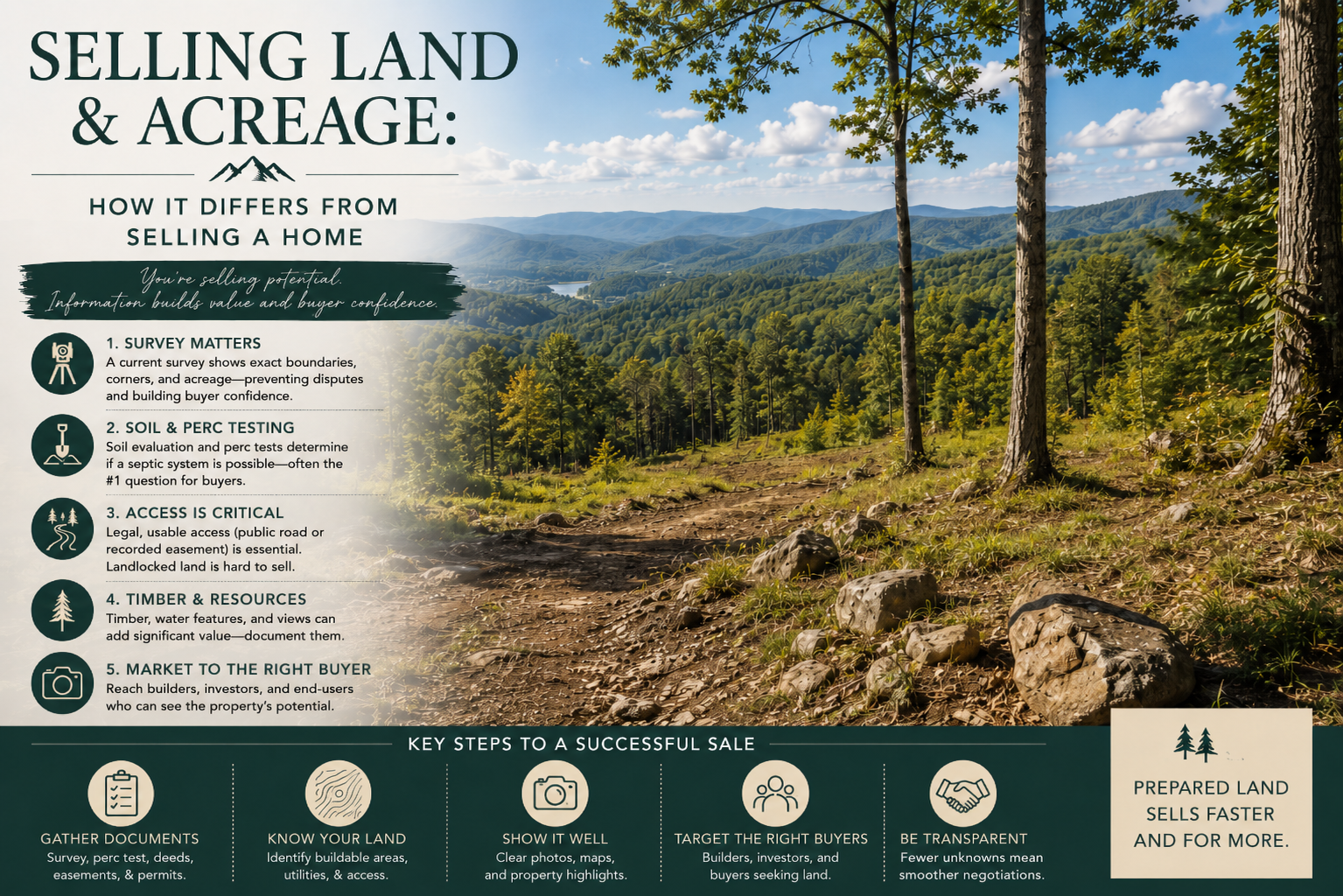
Selling raw land is a different exercise than selling a house, and in the mountains the differences run deep. Selling land in the mountains means a buyer is purchasing potential rather than a finished home, so the questions shift from kitchens and roofs to whether the parcel can be built on at all: where the boundaries actually lie, whether the soil will support a septic system, how you legally reach the property, and what the slope and the views allow. Get those answers ready in advance and you turn a buyer's uncertainty into confidence — which is what sells land. Here's how the process differs and how to prepare.
Key Takeaways
- Land buyers purchase potential, so reducing their uncertainty is the key to selling.
- A current survey clarifies boundaries and acreage and heads off disputes.
- Soil and perc testing shows whether the parcel can support a septic system for building.
- Legal, usable access and any easements are make-or-break for mountain land.
- Marketing land well means reaching builders and end-users who can see its potential.
Why land sells differently
When someone buys a house, they can walk through it and largely see what they're getting. Land is different: a buyer is imagining what could be built, and that imagination is shadowed by questions a finished home would already answer. Can I actually build here? Where exactly does my property end? Will a septic system work? Can I get a driveway in? How much will site work cost on this slope? Every one of those unknowns is a reason to hesitate or to discount the offer. The seller's job, then, is less about staging and more about removing uncertainty — assembling the facts and documents that let a buyer (and their builder or lender) see the path from raw parcel to finished home. The more confidently a buyer can answer those questions, the more your land is worth to them, and the faster it tends to sell.
Surveys, soil, and what a parcel can support
A few pieces of due diligence do the heavy lifting when selling mountain land:
- Survey — a current survey clarifies exact boundaries and acreage, locates corners, and prevents the disputes that vague property lines invite.
- Soil / perc testing — because most mountain parcels rely on septic, a soil evaluation showing where (and whether) a system can be permitted is often the single most valuable document you can provide.
- Topography and building site — identifying a feasible, relatively level building site on a sloped parcel helps a buyer picture the home and budget the site work.
- Utilities — knowing whether power, water (well or municipal), and internet can reach the site, and at what rough effort, removes more guesswork.
Having these answers in hand reassures buyers and their lenders, and it can be the difference between a parcel that sits and one that sells.
Access and easements
Access can make or break a mountain land sale, and it's one of the first things a serious buyer or their attorney will investigate. The key question is whether the property has legal, usable access — frontage on a public road, or a recorded, deeded easement across neighboring land that actually allows you to build a driveway and bring in utilities. A parcel that looks beautiful but is reached only by an unrecorded path, or that's effectively landlocked, is far harder to sell and finance. If access runs across someone else's land, the easement should be documented and clear about what it permits. It's worth confirming the status of access and any easements before listing, so you can present it plainly rather than discovering a problem mid-transaction. Clear, legal access is one of the most valuable features a piece of mountain land can have, and ambiguity around it is one of the most common deal-killers.
Timber, resources, and other value
Mountain acreage can carry value beyond its building potential, and it's worth understanding what your parcel offers. Standing timber may have value, though harvesting it changes the look and feel of the land and isn't always the best move for resale, since many buyers prize mature trees and privacy — it's a trade-off worth weighing rather than assuming. Other features can add appeal: a creek or spring, a pond, a long-range view, road frontage, gentle topography, or proximity to a lake or national forest. Mineral or water rights, where relevant, are worth clarifying. The point is to know and be able to articulate what makes your specific parcel desirable, whether that's a buildable knoll with a view, usable pasture, frontage on a stream, or simply a quiet, wooded retreat. Different buyers value different things, and matching your land's genuine strengths to the right audience is central to selling it well rather than leaving value on the table.
Marketing land to the right buyer
Land attracts a different audience than a finished home, and reaching it takes a tailored approach:
| Buyer type | What they look for |
|---|---|
| Builders & developers | Buildable sites, access, perc, clear path to construction |
| End-users / dream-home buyers | Views, privacy, a site they can picture their home on |
| Recreational buyers | Acreage, woods, water, proximity to forest or lake |
| Investors | Value, potential to subdivide or hold, road frontage |
Good land marketing leans on aerial and drone imagery to show the parcel's shape and setting, clear maps and boundaries, and an honest account of access and buildability — the very facts that move land.
Preparing land for the market
A little physical preparation helps land show as well as a home would. Where it's feasible and permitted, clearing an overgrown access path, marking the corners and boundaries, brushing out a potential building site, or reopening a grown-in view can transform how a parcel feels to a walking buyer — turning an impenetrable thicket into something they can actually picture living on. Even simple steps like a mowed entrance and a clear sign help. Pair that with the documents — survey, soil work, access details — and aerial imagery that captures the land from above, and you give buyers everything they need to act with confidence. Pricing land also calls for care, since comparable sales can be scarce and values hinge on buildability and features rather than square footage. The combination of physical presentation, solid documentation, and the right pricing and marketing is what turns mountain acreage from a long, quiet listing into a sale.
Patience and pricing in the land market
One more thing worth setting expectations around: land often takes longer to sell than a finished home, and that's normal rather than a sign something is wrong. The pool of buyers for raw acreage is smaller than for move-in-ready houses, and those buyers tend to do more deliberation — running their own numbers on site work, financing, and feasibility — before they commit. Land financing also works differently than a typical home mortgage, which can lengthen the process. All of this makes patience and realistic pricing especially important. Because comparable land sales can be sparse and every parcel is unique in its slope, access, and buildability, pricing is more art than formula, and an overpriced parcel can sit untouched for a very long time. Pricing it sensibly from the start, backed by the documentation that proves its potential, is the surest way to attract the right buyer in a reasonable timeframe. Understanding the rhythm of the land market up front helps you sell with confidence rather than frustration, and keeps you from reacting to the natural quiet of the early weeks.
Frequently Asked Questions
Is selling land harder than selling a house?
It's different rather than simply harder. Land buyers are purchasing potential, so the sale hinges on answering questions about buildability, boundaries, access, and septic, rather than showing finished rooms. Good preparation makes it much smoother.
Do I need a survey to sell my land?
A current survey isn't always required, but it's highly valuable: it clarifies exact boundaries and acreage, locates corners, and prevents disputes, which reassures buyers and lenders and helps the sale go smoothly.
What is a perc test and why does it matter?
A soil or perc evaluation shows whether and where the land can support a septic system. Because most mountain parcels rely on septic, this is often the single most important document for proving a parcel is buildable.
Why is access so important for mountain land?
A buyer needs legal, usable access — public road frontage or a recorded easement — to build a driveway and bring in utilities. Landlocked or unclear access makes a parcel much harder to sell and finance.
Should I cut the timber before selling?
Not necessarily. Timber may have value, but harvesting changes the land's look and many buyers prize mature trees and privacy. It's a trade-off worth weighing for your specific parcel and market rather than assuming.
Selling your land with The DuPree Real Estate Group
Selling mountain land well takes preparation, the right documents, and marketing aimed at the right buyer. The DuPree Real Estate Group works with land and acreage across the region and can help you present a parcel at its best. When you're ready, reach out to Bonnie DuPree to talk through your property, or explore the local market to see how land is presented.
The DuPree Real Estate Group is pledged to the letter and spirit of U.S. policy for the achievement of equal housing opportunity. Bonnie DuPree, REALTOR® · RE/MAX Town & Country · Each Office Independently Owned and Operated.
Check out this article next

Leave a Reply